Peak Stuff
IKEA furniture is….everywhere. And as with anything that’s so seemingly omnipresent, for every voice bemoaning its drawbacks there are 100 twenty- and thirty-somethings jumping into the car to spend a Saturday afternoon touring the labyrinthine depths of the closest IKEA because, let’s face it, you just need a coffee table for that empty space in the apartment and don’t want to think about it too much. And be honest, you’ll probably eventually throw it away.
Does this confirm what many claim, that IKEA sells throwaway furniture for a disposable culture? Where does that leave us in our relationship with our TOVIKs and POANGs? Has it brought out the worst in our consumerist selves? Are we striking a deal with the devil for the sake of short term practicality, or can we learn to stop worrying and love IKEA?
Does affordability always mean disposability?
IKEA itself, perhaps unsurprisingly, challenges the notion that affordability is by definition tantamount to disposability. Certainly this doesn’t have to be the case, but those of us who live in areas where apartment turnaround is high or have large student populations can attest to the piles of used furniture that clutter the sidewalks on move-in day (here in the Boston area we call it “Allston Christmas”). Very little of that which has been disposed of is worth a second look to even the most ingenious of scavengers, and most of it is from (you guessed it), IKEA.
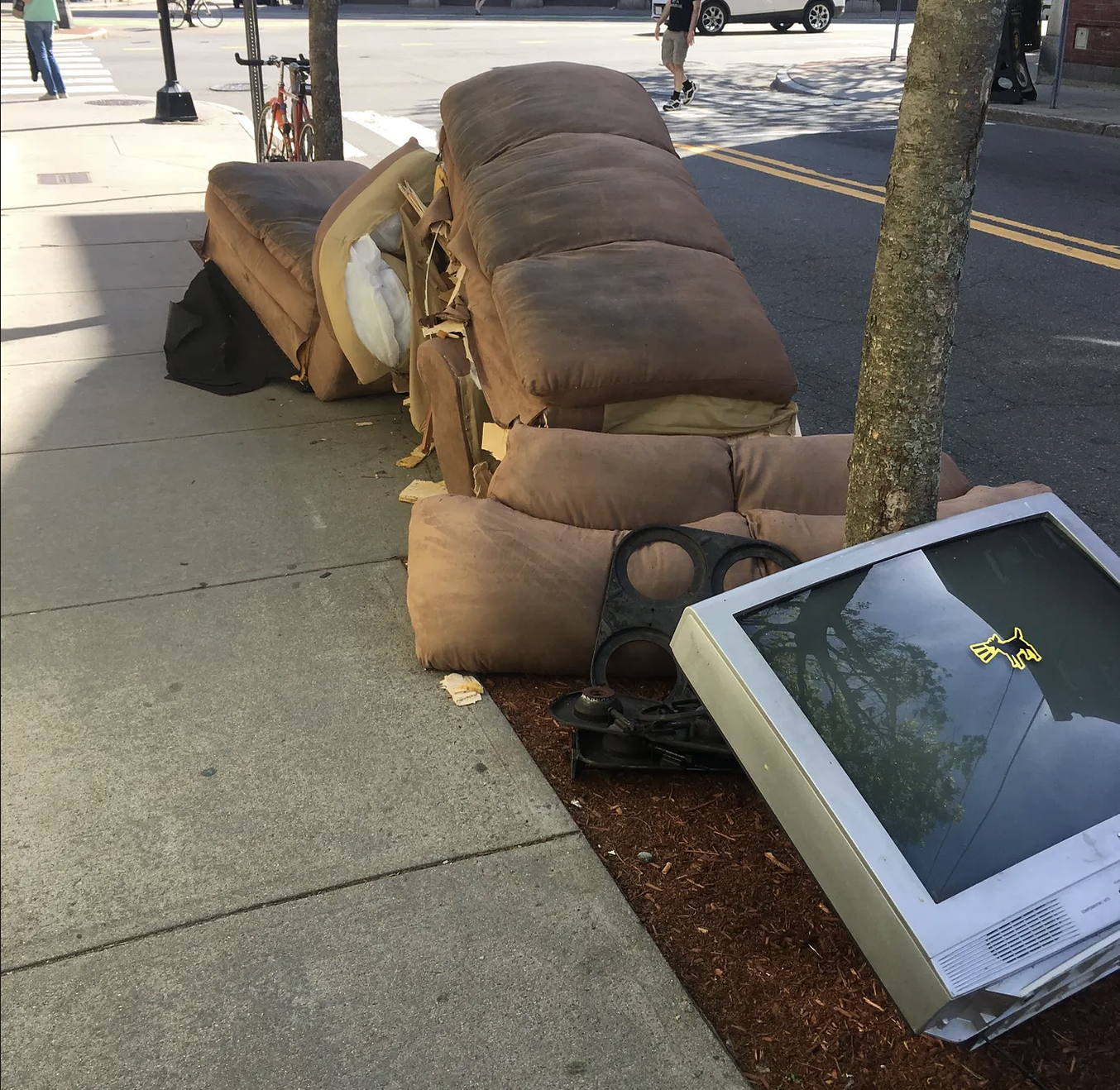
For those either somewhat phobic of committing to a space or simply cash poor, IKEA is the best option for furnishing an apartment inexpensively and in a way that looks finished and intentional. And that’s by design.
Ingvar Kamprad, who died in 2018, focused his young company IKEA on furnishings back in the 1940’s, in part because he felt that the people in his region of Sweden deserved to have nice furniture at a price point they could afford. The company was quickly shunned by the furniture industry in the area, driven by complaints from other retailers who couldn’t compete with him on price, leading IKEA to design and make its own furniture.
Even today, IKEA famously designs its furniture according to principles that will keep its furniture affordable, often giving designers a price point as a starting constraint, which extends beyond the materials and processes used to make an item to the overhead associated with shipping, storing, and distributing the furniture.
The most famous of these principles are flat pack design, the use of particleboard and fiberboard in many of the company’s products, and the requirement that customers assemble the furniture themselves.
Interestingly, the constraints aimed at efficiency and keeping costs down are the same constraints that make IKEA a better environmental steward, at least in some ways, than other furniture companies. Flat pack, for example, fits far more furniture into every truck and shipping container.
For all its talk of savings because of flat pack design, almost anyone who’s tried to disassemble and reassemble a piece of IKEA furniture can probably expect at least some lost tools or fasteners, a cracked plank, or a door that has somehow gone permanently out of plumb. Which is to say, flat pack in the other direction seems to remain a bit of a unicorn.
The result? That low, low price doesn’t end at the register. Removal and disposal cost something too. In 2018, the last year anyone counted, Americans threw out 12.1 million tons of furniture and furnishings, and about 80% of it went to landfill, according to the EPA. The agency hasn’t published a newer count, and after the cuts of 2025 it may never. We as taxpayers foot the bill to haul it away and bury it, and we as global citizens have a limited timeline for ignoring the trash that doesn’t really go away.
Affordability and disposability of what could be thought of as “temporary possessions” are the conditions for a booming consumer economy. And it’s not limited to furniture. Think about clothing brands like H&M or Zara, or Shein today, that (likely) serve a practical purpose (I need a new going-out top) and capture the style of the season. And when that practical purpose is gone or the style is passed, you don’t feel even remotely guilty about sending it to Goodwill or more likely the trash.
Does affordability automatically equate to disposability? Certainly not. I have plenty of stuff floating around that I bought for cheap (e.g. sunglasses) but they do the trick and I know it would be a pain finding something similar that was as right as that object.
But is affordability a precondition of disposability? Absolutely. Unless you’ve got a million bucks to throw around, your threshold for tossing something vs. making it work is very likely tied up in how much it cost to buy the item in the first place and how much it costs to replace or upgrade it now.
The Age of Peak Stuff
Before you put IKEA in your environmental crosshairs, know that the company understands the problem better than most. Nobody in the furniture industry talks about sustainability more boldly.
A consumer company selling durable goods would be in a very awkward position if it tried to convince you that you shouldn’t want to buy things. Oddly, though, that’s essentially what Steve Howard preached as IKEA’s chief sustainability officer.
At a Guardian debate in 2016, Howard said the West had probably hit “peak stuff,” even “peak home furnishings.” We who live in resource-rich societies have already made everything we could possibly need. It just might not meet our creative need or desire for self-expression in its current configuration. In the same breath, Howard said his comment didn’t undermine IKEA’s goal of doubling its sales by 2020. He left the company the following year.
At present though, the world of home furnishings, like much of the economy, relies on disposing and replacing, rather than transforming. Our whole society is filled with a bunch of placeholder stuff, and IKEA still leads the pack in providing those objects. Our entire economy thrives on buying, replacing, and disposing.
However, replacing doesn’t seem quite so bad if the new product actually reconfigures materials that used to be something else. Better still is when the old product never has to stop being itself. IKEA’s Buy Back & Resell program pays customers store credit for their used IKEA furniture and puts it back on the floor in the As-is section. It reached the United States as a pilot in 2021 and has since spread to nearly every American store. That’s the circular IKEA Howard promised, and it works.
The wood tells a different story. IKEA buys more wood than any other company in the world. In 2020 the watchdog Earthsight traced illegally logged Ukrainian beech into IKEA’s Terje chairs, and that wood carried a Forest Stewardship Council label. IKEA says it does not accept illegal wood, and it asked the FSC to audit its supply chain. Campaigners have since accused IKEA of logging old-growth forest on land it owns in Romania, which IKEA disputes.
And before you harp on particleboard and MDF (medium-density fiberboard) too badly, remember that a lot of both comes from sawmill scraps and offcuts that otherwise would have gone to waste.
Still, some would call all of this greenwashing.
Does that mean IKEA is the devil? Of course not. For many people it’s been really useful at some important moments, and I for one am glad it was there. I couldn’t care less whether business exigencies or genuine environmental concern drive IKEA’s commitments. Let’s judge them as we would be judged, on results. The results come out mixed. The buyback proves that a cheap chair can live more than one life. The forests show how much a promise depends on who checks it. The cheapest piece of furniture is still the one you already own, and the most sustainable choice is always the pre-loved piece you can pick up at an affordable price anyway.